
The Best Fall Foliage Train Rides in the U.S.
by Wanderu
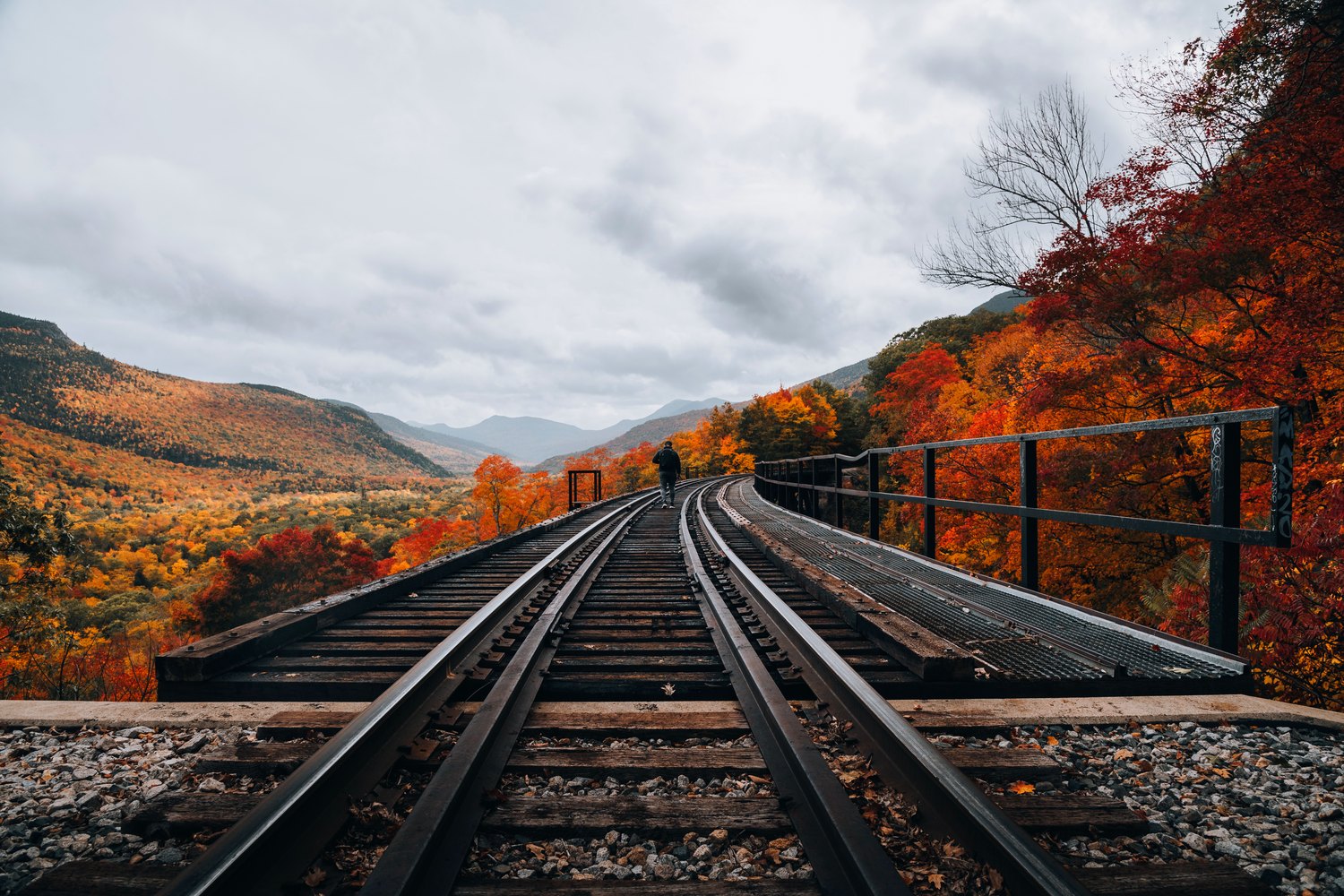
A train is the right way to look at autumn. You get a wide window, someone else is driving, and the track goes through river valleys and mountain notches that no road reaches. The trouble is that most lists of fall foliage train rides will happily send you out on a train that crosses all of it after dark.
Two questions decide it, and the pretty pictures never answer either one. Which direction has the light, and which week does the color actually turn. Every ride below runs its good part in daylight, and every one is a route we sell tickets for, so the fares here are real ones.
| Destination | Travel time | From |
|---|---|---|
| Boston to Portland, Maine | 2 hours 35 minutes | $26 Amtrak$16 Concord Coach Lines |
| Boston to North Conway, New Hampshire | 3 hours 35 minutes | $38 Concord Coach Lines |
| Boston to Pittsfield, Massachusetts | 3 hours 52 minutes | $16 Amtrak$11 Greyhound |
| New York to Hudson, New York | 2 hours 5 minutes | $35 Amtrak |
| New York to Poughkeepsie, New York | 1 hour 25 minutes | $26 Amtrak |
| New York to New Paltz, New York | 1 hour 35 minutes | $24 Adirondack Trailways |
| New York to Albany, New York | 2 hours 31 minutes by train, 2 hours 45 by bus | $45 Amtrak$12 Bus |
| New York to Saratoga Springs, New York | 4 hours 5 minutes by bus, 4 hours 13 by train | $50 Amtrak$27 Adirondack Trailways |
| New York to Burlington, Vermont | 7 hours 2 minutes | $70 Amtrak |
| Washington to Harpers Ferry, West Virginia | 1 hour 11 minutes | $19 Amtrak |
| Philadelphia to Pittsburgh | 7 hours 23 minutes by train, 6 hours 55 by bus | $68 Amtrak$39 Greyhound |
| Sacramento to Reno | 5 hours 14 minutes | $60 Amtrak |
| Salt Lake City to Denver | 15 hours 39 minutes | Amtrak |
Three things decide whether a foliage trip works
None of them is the one you’d expect, so take them in order.
- Direction, which matters more than the route. A train timetable is a fixed thing, and it puts the same stretch of country in daylight going one way and in the dark going the other. The Empire Builder along the Columbia River Gorge is the sharpest example we found: eastbound out of Portland in November you get about six minutes of the Gorge before the sun sets. Westbound, on the morning train, you get the whole of it. Same track, same scenery, different answer.
- The week, which moves with latitude and elevation. Colorado’s high country is finished before most of New England has started. Any date you read is a target with a week or two of slop in it, weather depending. Trees don’t read press releases.
- When you book, which is where the money is. Not the season. More on that below, because it’s the part that surprised us.
This isn’t a list of heritage railroads. Most of the famous ones sit in towns with no scheduled bus or train service at all, so a list of them is a list of places you need a car to reach. We name the one exception, in New Hampshire, where you genuinely can get to the platform without driving. If it’s year-round scenery you’re after rather than autumn specifically, we keep a separate guide to the twelve most scenic rides on the Amtrak map.
When each region peaks
Published windows from the people who track it for a living: state, provincial and federal land and tourism agencies, and one regional association. Treat each as the middle of a range rather than a date to book against.
| Region | Typical peak | Who says so |
|---|---|---|
| Colorado high country (9,000–11,000 ft) | Early September, moving downhill through the month | National Park Service |
| Adirondacks and Lake Champlain | Late September to mid-October | I Love NY |
| Vermont’s Green Mountains | Last week of September into the first half of October | Vermont Department of Tourism |
| White Mountains, New Hampshire | End of September to the second week of October | White Mountains Attractions |
| Québec City | First week of October | Bonjour Québec |
| Central Pennsylvania (Horseshoe Curve) | October 10 to 20 | Pennsylvania DCNR |
| The Catskills | Early to mid-October | I Love NY |
| Coastal and southern Maine | Mid-October to the end of the month | Maine Forest Service |
| The Hudson Valley | Mid-October into early November | I Love NY |
| Eastern Panhandle, West Virginia | Late October | West Virginia Tourism |
| Montréal | Third to fourth week of October | Bonjour Québec |
Two of these are worth a second look. Colorado is the outlier and it catches people out every year. The aspen up at 9,000 to 11,000 feet go in the first days of September and work downhill through the month, which makes the Salt Lake City train an early-September trip rather than an autumn one.
The Sierra crossing spans two bands at once. High country turns from the middle of September; the foothills at the bottom of the climb hold on into November. That is why that ride reads well across a long stretch of the season.
New England
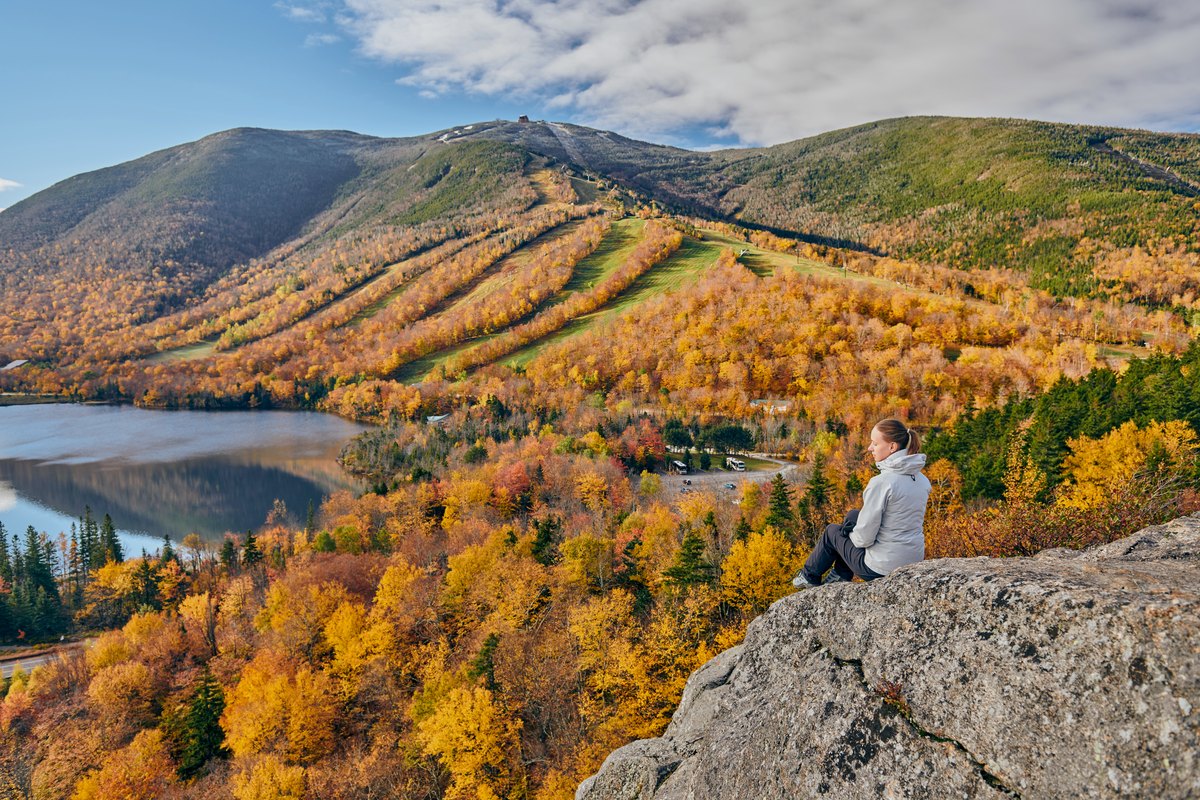
This is where our travelers actually go in October, and it’s the one part of the country where the good rides are also the cheap ones. Everything here is under four hours.
Boston to Portland, Maine
2 hours 35 minutes
- Boston to Portland trainsfrom $26
- Boston to Portland busesfrom $16
The Downeaster is the easiest foliage train in the country to actually catch. Five round trips a day, just over two and a half hours, and the last hour north of the New Hampshire line is the good part, running through salt marsh and hardwood with the color right up against the window. Three of the five southbound runs are still in daylight at the end of October.
The bus is cheaper. Concord Coach runs the same city pair and our travelers book it about eight times as often as the train, at a typical $31.99 against $38.99 on the Downeaster. The train is more comfortable and has the better windows. The bus has the better price. Both are on the page above so you can pick.
Worth knowing before you plan around a fare: Downeaster tickets barely move with notice. Booked a month out or booked that morning, our travelers paid about the same $39. It’s a fixed-price service, so there’s nothing to gain by booking early and nothing to lose by deciding at breakfast.
Boston to North Conway, New Hampshire
3 hours 35 minutes
- Boston to North Conway busesfrom $38
Almost every list of fall foliage train rides is mostly excursion railroads, and almost none of them tells you how to reach one without a car. North Conway is the exception, and it’s the reason it leads this section. Concord Coach runs straight from South Station to the Eastern Slope Inn in the middle of the village, about three and a half hours, no transfers, twice a day.
You get off on the village high street. The Conway Scenic Railroad’s station is a quarter of a mile down Main Street past Schouler Park, about five flat minutes on foot, and its Mountaineer climbs from there into Crawford Notch and back in four to four and a half hours.
One thing decides your whole trip. The earliest bus from Boston reaches North Conway at 1:45 in the afternoon. The last Mountaineer of the day leaves at 1:30. You miss it by fifteen minutes, so this cannot be done as a day trip.
Stay the night instead and it works beautifully: bus up on the 10 o’clock, in by quarter to two, train at nine the next morning, back in the village by half past one, and the 2:30 bus home. Book the train straight from the railroad, which runs two departures a day through October. Wanderu doesn’t sell that ticket. If you want the glass-roofed dome car, book well ahead: the railroad says it often sells out weeks in advance, especially in peak color season.
Boston to Pittsfield, Massachusetts
3 hours 52 minutes
- Boston to Pittsfield trainsfrom $16
- Boston to Pittsfield busesfrom $11
The Lake Shore Limited is the train into the Berkshires from Boston, and the timing is kinder than the length suggests. Leaving Boston just before one in the afternoon, it crosses the hills between about half past three and a quarter to five, which is the best light of the day for them. If you are coming from New York instead, note that the seasonal Berkshire Flyer only runs in summer.
The train is also the better bargain here more often than the headline price suggests. A typical ticket runs about $38.75, but a quarter of the tickets went for $18 or less. The bus is a little cheaper on a typical day, and our travelers book it more often.
New York and the Hudson Valley
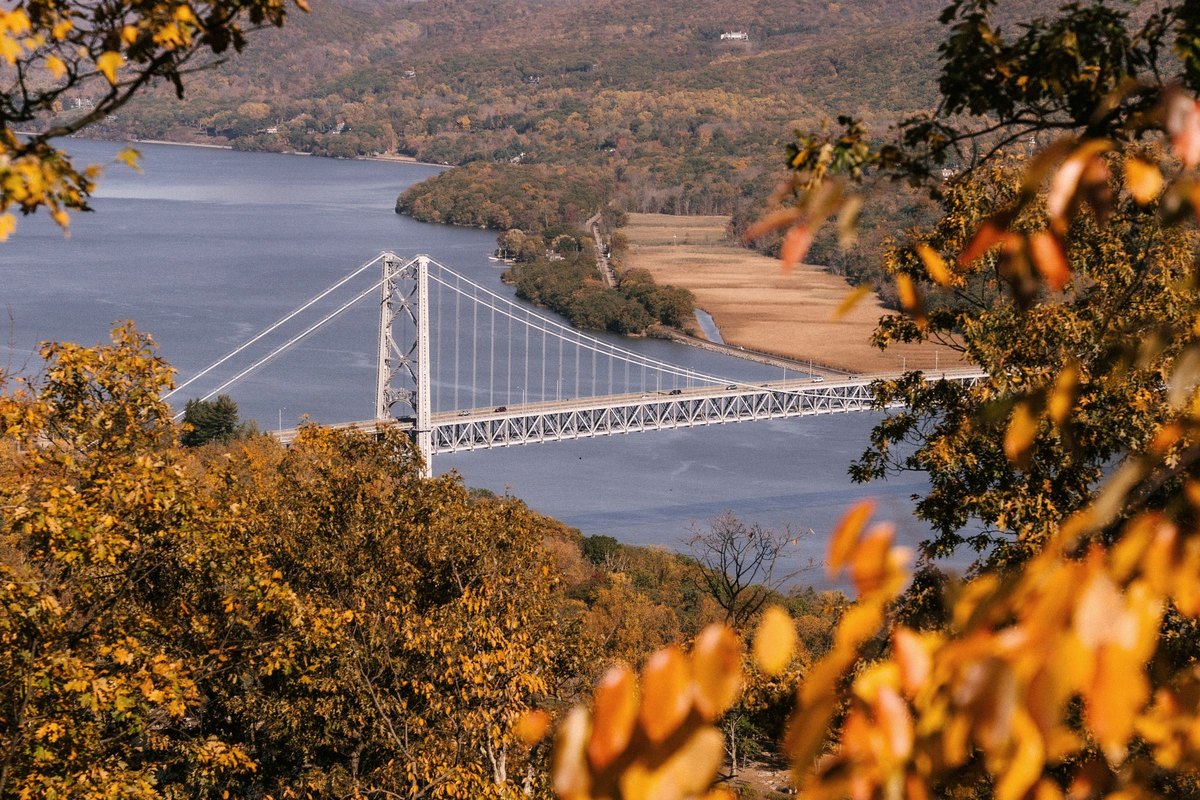
The Hudson Line is the most underrated foliage ride in America, mostly because people think of it as a commute. It runs along the water for nearly its whole length, and you can be back in the city the same night.
New York to Hudson, New York
2 hours 5 minutes
- New York to Hudson trainsfrom $35
Two hours up the east bank, and for most of it the river is the view. There’s no bus on this one, so the train wins by default, which is a rare thing to be able to say. Hudson itself is a walkable main street of antique shops and restaurants that starts at the station door, and it’s the usual jumping-off point for the Catskills across the water.
New York to Poughkeepsie, New York
1 hour 25 minutes
- New York to Poughkeepsie trainsfrom $26
The easiest way to put yourself on the river. About fifteen minutes on foot from the station is the Walkway Over the Hudson, a former railway bridge that crosses the water more than two hundred feet up. There is no better place to stand and look at a valley in color. Trains run all day, so this one works as a decision you make in the morning.
New York to New Paltz, New York
1 hour 35 minutes
- New York to New Paltz busesfrom $24
The shortest ride on this page and the most-booked day trip in the Hudson Valley by a wide margin. Adirondack Trailways runs it in an hour and thirty-five minutes for a typical $34.74. New Paltz sits under the Shawangunk Ridge, so the color here is something you walk into rather than watch through glass.
New York to Albany, New York
2 hours 31 minutes by train, 2 hours 45 by bus
- New York to Albany trainsfrom $45
- New York to Albany busesfrom $12
Albany is the gateway to the Adirondacks and the busiest thing on this whole page: we sold more than thirty thousand bus tickets on it in the year to September 2026. And here the honest answer isn’t the train. The bus runs $31 against about $52 on Amtrak, and gives up fourteen minutes to do it. The train has the better windows along the river. You’re paying about twenty dollars for them.
New York to Saratoga Springs, New York
4 hours 5 minutes by bus, 4 hours 13 by train
Saratoga is the southern door to the Adirondacks, and it’s here for a reason that took some digging to find. The Adirondack is the train everyone recommends for this, because it runs up the Hudson and along Lake Champlain to Montreal and deserves the reputation. But it only makes the full run midweek, and the two directions don’t even line up: northbound Monday to Thursday, southbound Tuesday to Friday. Every other day it turns back at Saratoga Springs, which covers exactly the weekend most people are trying to travel on.
So treat Saratoga as the weekend version rather than a consolation. It gets you the whole Hudson stretch, which is the part with the water in it, and the town has a spa state park, mineral springs and a main street at the end of it. The bus is the cheaper way there by a wide margin, a typical $49.19 against $79 on the train, and it gets there eight minutes sooner.
New York to Burlington, Vermont
7 hours 2 minutes
- New York to Burlington trainsfrom $70
The Ethan Allen Express is the one long ride on this page that is entirely in daylight, and it’s worth arranging your trip around the direction. Southbound it leaves Burlington at 9:25 in the morning and reaches New York at 4:27 in the afternoon, which puts the Green Mountains and then the whole Hudson Valley outside your window in sequence, in one seat, with the sun on them the entire way.
Take the train, not the bus, on this one. They cost about the same, and the bus takes over ten hours. But know what you’re buying: October is the single most expensive month of the year on this route. A typical ticket is $95 in October against $74 in January. That’s the clearest example on this page of something worth saying plainly, which is that foliage season is not a discount.
The Mid-Atlantic
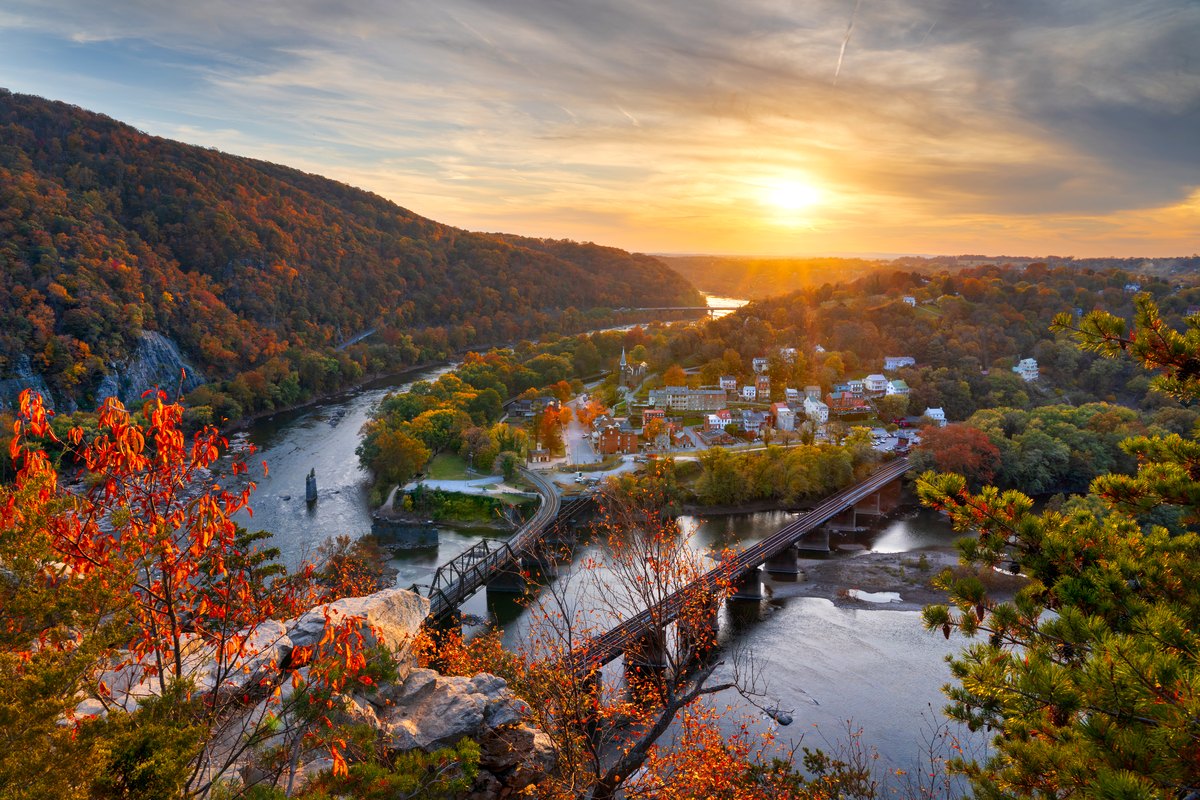
Two rides here, and one of them is the best value on the whole page by a distance.
Washington to Harpers Ferry, West Virginia
1 hour 11 minutes
Seventy-one minutes from Washington and you step off into a national historical park at the meeting of the Potomac and the Shenandoah, with wooded ridges going up on three sides. A typical ticket is $32, and a quarter of them went for about $25 or less, which for the scenery involved is the best exchange rate on this page.
Read the timetable before you build a day around this one, because it runs once each way. The train out of Washington leaves at 4:05 in the afternoon and gets in at 5:16, which in late October leaves you under an hour of light. The train back leaves Harpers Ferry at 11:31 in the morning, so there is no same-day return. This is an overnight or it is nothing.
Do it as an overnight and the arithmetic turns in your favor: evening light on the water, a night in town, and the whole of the next morning in the park before an easy ride back. Check one thing first. The footbridge that carries the Appalachian Trail across the Potomac has been closed since July 2026 with no reopening date announced, so look up its status before you plan a walk around it.
Philadelphia to Pittsburgh
7 hours 23 minutes by train, 6 hours 55 by bus
The Pennsylvanian is the only passenger train that takes you around Horseshoe Curve, which bends more than two hundred degrees around a valley head in the Alleghenies and was built to get trains over mountains that wouldn’t otherwise allow it. Direction decides what you see. Going west from Philadelphia you reach the curve around a quarter past five in the evening, which is fading light by late October. The eastbound train from Pittsburgh takes it around ten in the morning in full light, and that is the one to book if the curve is the point.
That’s the case for the train, and it’s the whole case, because the bus beats it on both numbers that usually matter. The bus is about ten dollars cheaper and close to half an hour quicker. If you want the curve, pay for the curve knowingly.
The West
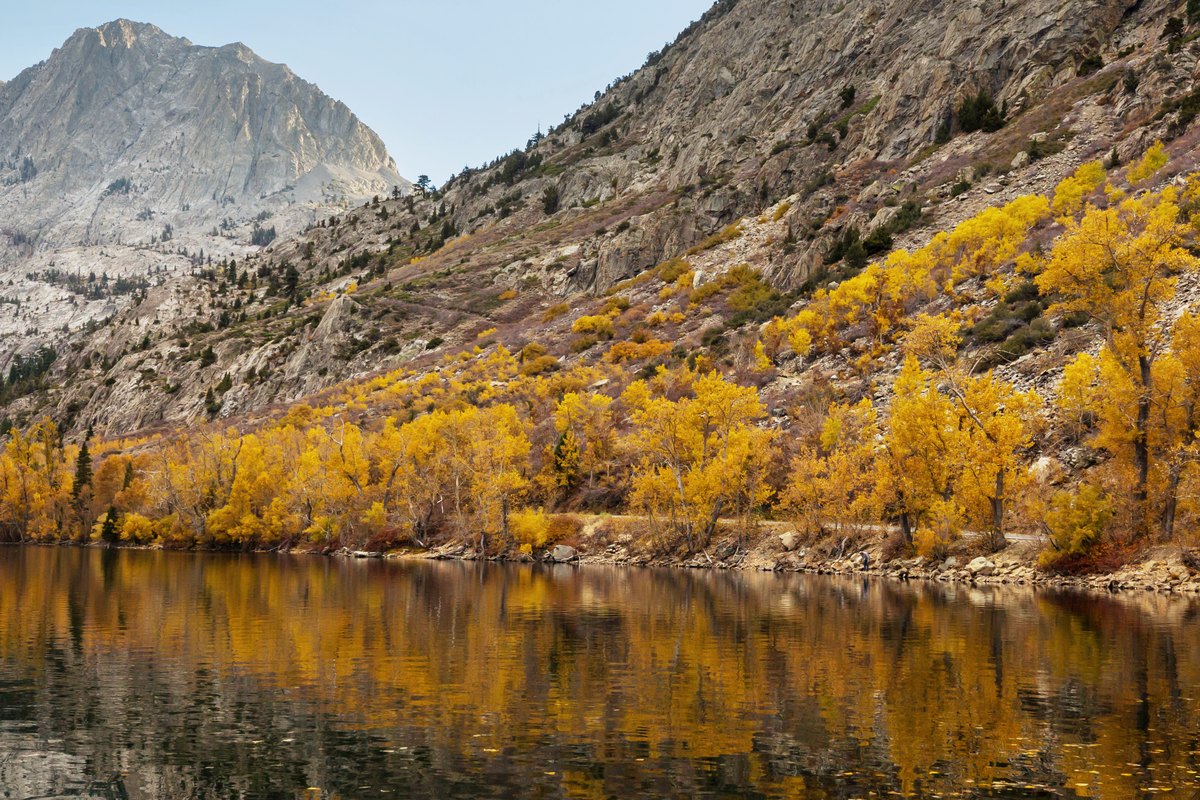
Western foliage is aspen and cottonwood rather than maple, so it reads gold against evergreen instead of red against red. Both of these are long days, and both are worth it for the right traveler.
Sacramento to Reno
5 hours 14 minutes
- Sacramento to Reno trainsfrom $60
Hardly anyone books this one, which is a shame, because the timing is perfect. The California Zephyr leaves Sacramento at 10:23 in the morning and reaches Reno at 3:37 in the afternoon, which means the whole thing is in daylight, in every week of the season, including November. Donner Pass comes somewhere around half past twelve to half past one, and the train spends it on ledges above the canyon that no road gets near.
Salt Lake City to Denver
15 hours 39 minutes
- Amtrak
The most spectacular daylight on this page belongs to a train almost nobody books. We sold eleven tickets on it in a year, so we’re not going to pretend it’s a product; take it as a recommendation from people who look at train timetables too much. It leaves Salt Lake City at 3:20 in the morning, which is not dawn and not pleasant. What you get for it is roughly eleven and three-quarter hours of light covering the entire state of Colorado: Ruby and De Beque canyons through the morning, Glenwood Canyon around twenty to twelve, then the long climb to Winter Park at half past three and the Moffat Tunnel near four, and down into Denver at 6:59 in the evening.
The catch is the calendar. Colorado’s high country turns early, well before the eastern states do, so this is a September trip in a season most people think of as October.
One more, across the border
Montréal to Québec City is three and a half hours along the St. Lawrence on VIA Rail, and it has a trick none of the American routes can match. Québec City peaks in the first week of October. Montréal, at the other end of the same line, doesn’t peak until the third or fourth week, about two to three weeks later. Ride it in between and you travel along the gradient, leaving a city that hasn’t turned for one that already has.
It’s a scheduled train, not a sightseeing special, running several times a day, so you can build a real trip around it. VIA reworks its timetable in late October, so check the day you want. Fares here have been climbing, so take the live figure on this page over anything you read elsewhere. If you’re starting from Montréal there are more cheap ways out of the city than most people expect.
- Montréal to Québec City trainsfrom $30
When to book, and why it isn’t about the season
Autumn is not a sale. The data is unambiguous. We compared each corridor against its own annual median, which strips out the fact that some routes are simply more expensive than others. September came in at 95.5 and October at 99.2, against a typical month of 100. Every corridor sits within a few percent of its own normal, and if anything September is fractionally cheaper. The months that genuinely cost more are November and December, at about 11% above a typical month, and the cheapest month of the year is January.
Some foliage routes are actually at their yearly peak in October. New York to Burlington is typically $95 that month against $74 in January. So if you’ve been waiting for leaf season to bring fares down, stop waiting.
What does move the price is notice. More than half of autumn train tickets, 55.6%, are booked within three days of travel, and only one in five is booked two weeks or more ahead. Comparing like with like, the same route on the same service, the tickets booked two weeks out came in about 27% cheaper. That held on 86% of the route-and-service combinations we checked.
The exception is worth knowing because it saves you the anxiety. Some services have fixed fares that don’t move at all: the Downeaster to Portland is one, and its price is the same the month before as it is the morning of. Book those whenever you like. It’s the yield-managed routes, which is most of Amtrak, where two weeks of notice is worth real money. The same habit works on the road, and we go into it further in our guide to finding the cheapest seats.
One last thing in favor of going. September and October are the two busiest months of the year on the trains we sell, about 24% above a typical month. Everyone else has worked out that this is the good season too. They just haven’t worked out that it doesn’t cost extra. If you’re building a longer trip around it, we also keep a list of autumn festivals worth planning a trip around.
Frequently asked questions
What is the best train ride to see fall foliage?
For most people it is the Downeaster from Boston to Portland, Maine: just over two and a half hours, five round trips a day, and color along the track for the last hour. If you want a long one, the Ethan Allen Express southbound from Burlington to New York runs seven hours entirely in daylight and crosses the Green Mountains and the Hudson Valley in a single seat. For the best value, Washington to Harpers Ferry is 71 minutes and a typical $32.
Does it matter which direction I take the train?
More than anything else on this page. A train that crosses beautiful country after dark shows you nothing, and several well-known foliage routes do exactly that. Ride the Ethan Allen and the Vermonter southbound, the Pennsylvanian and the Capitol Limited eastbound, and the Empire Builder westbound through the Columbia Gorge. The reverse of each runs the same scenery in darkness.
Are train tickets cheaper during fall foliage season?
No. We compared each corridor against its own annual median and September and October came in at 95.5 and 99.2, which is flat. If anything some foliage routes are at their most expensive: New York to Burlington is typically $95 in October against $74 in January. The two months that genuinely cost more are November and December, at about 11% above a typical month.
When should I book a fall foliage train?
Two weeks or more before you travel, on most routes. Comparing like with like on the same route and service, travelers who booked 14 or more days out paid about 27% less than those who booked within three days, and 86% of the route-and-service combinations we checked were cheaper that way. The exceptions are fixed-fare services: the Downeaster costs the same whenever you buy it, so there’s nothing to gain by booking it early.
When is peak fall foliage?
It’s latitude and elevation more than the calendar. Colorado’s high country turns first, in early September. Québec City peaks in the first week of October, and Montréal, three and a half hours away, not until the third or fourth week of the month. Coastal Maine runs from the middle of October to the end of the month. Any published window moves by a week or two with the weather, so treat it as a target rather than a booking date.
Can I get to a scenic railroad without a car?
Usually not, which is why this page names only one. Most excursion railroads sit in small towns with no scheduled bus or train service at all. The exception is the Conway Scenic Railroad in North Conway, New Hampshire: Concord Coach runs from Boston’s South Station to the middle of the village in about three and a half hours with no transfers, and the railroad’s station is in the same village. Wanderu doesn’t sell excursion railroad tickets, so buy that one from the railroad.
The “from” prices on this page refresh from Wanderu’s route data: each is the cheapest fare recently available on that route, the same figure its route page shows. What you pay depends on when you book. “Typical” fares are the median paid per passenger on a single leg, across Wanderu tickets booked between September 2025 and September 2026. Seasonal figures are counted by travel month instead, over the two most recent complete autumns. Seasonal price and volume figures compare each route against its own annual median, so a busy route cannot drag the answer. Journey times and daylight are from the operators’ published timetables as of September 2026, and peak-color windows are from state, provincial and federal sources, all of which move with the weather. Wanderu doesn’t sell excursion railroad tickets.

Pssst — get our best stories in your inbox
One email a week. Cheap trips, honest guides, zero fake urgency. Chiku's got your back.